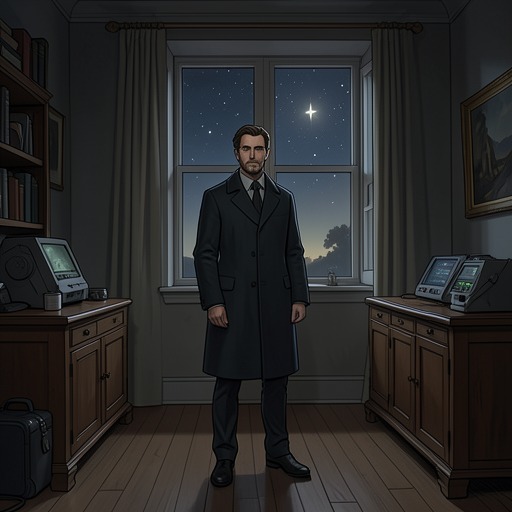
Nami
5 Centimeters per SecondNami is a resurrected woman in Agartha whose testimony gives the prohibition on raising the dead its most intimate meaning: her return from death cost her lover Eve her life. When Asuna and Ryuuji Morisaki seek out the person believed to have broken the taboo, Nami first denies that anyone has done so, then reveals that she herself was brought back. Her account turns Morisaki’s search for a way to resurrect his wife into a confrontation with what such a wish may demand of the living.
Identity and Isolation
Nami lives in the only house by the forest, outside the wooden wall that protects the other houses from external threats. Its position marks her as separated from the village: while the other homes are enclosed together, hers stands alone beyond their boundary. Asuna and Morisaki recognize the house at once, and Morisaki observes that the villagers’ knowledge of the broken taboo makes the isolation unsurprising. The setting associates Nami’s history with both a secret and a visible form of exclusion.
The house’s neglected condition extends that separation indoors. Its interior is described as miserable and decrepit, and Nami offers Asuna and Morisaki cushions on the rotting wooden floor as an attempt at hospitality. Nami herself is in her twenties, but her pallor makes her look unhealthy. These details present her not as a distant legend but as a person encountered in a particular, impoverished home. The effort to welcome visitors persists amid the house’s decay, even as its condition unsettles Asuna.
The Encounter and Revelation
Morisaki approaches Nami with a direct purpose: he explains that he lost his wife ten years earlier and has come from the surface to resurrect her. Nami initially insists that nobody in the village has resurrected the dead. After a pause, she distinguishes between the claim as he has framed it and the truth she is willing to disclose: someone was resurrected by her lover. Morisaki gasps, while Asuna briefly doubts that she has understood. Nami then identifies herself as the person at the center of that history.
Nami gives her name and says that her lover was Eve and that she died five years ago. Her matter-of-fact introduction makes the impossible fact of her own resurrection part of an ordinary conversation, an experience Morisaki recognizes as beyond anything possible on the surface. The delay before her admission, following her initial denial, makes the revelation feel guarded rather than offered as a public explanation. She does not simply confirm a rumor; she supplies the personal history that the rumor leaves out.
Instead of presenting resurrection as a procedure that can be repeated at will, Nami raises the question of its price. When Morisaki asks what must be paid, she explains that the cost varies with the time, the situation, and the individual. Her sadness accompanies a warning that the outcome cannot be treated as predictable or uniform. This uncertainty matters to Morisaki, who has crossed a great distance with a specific hope, but Nami’s own case gives that hope a human consequence before he can regard it as a solution.
Eve and the Price of Return
Morisaki eventually asks whether the price explains Eve’s absence. Nami slowly nods and tells him that Eve was the price of bringing her back: one life for another. The statement clarifies the relationship between the two women and the exchange at the center of Nami’s survival. She is alive because Eve is not; resurrection has not restored their life together but has separated them through the very act meant to overcome death.
Nami describes the sacrifice as having been for nothing and questions what meaning the world could hold for her alone. Her words present survival not as a simple reward but as a condition made painful by the loss it required. The account does not portray Nami as grateful for a return that erased the person she loved, nor does it suggest that Eve’s death can be repaired by the fact that Nami remains. Instead, the price leaves her facing a world in which the person for whom that world mattered is absent.
That outcome gives Nami’s story particular force in Morisaki’s search. His stated purpose is to bring back his wife, whom he lost ten years earlier; Nami’s experience demonstrates that the desire to restore a loved one can lead not to reunion but to another bereavement. Her explanation cannot tell Morisaki exactly what a resurrection would cost in his own circumstances, since she has said that the price varies. It can, however, prevent him from imagining resurrection as a consequence-free reversal of death.
Narrative Significance
Nami’s brief account changes the question surrounding the taboo. Before she speaks, the secluded house and the villagers’ knowledge suggest that a prohibited act has occurred. Her revelation shifts attention from whether resurrection is possible to what it takes from those involved. The rule is no longer only a boundary maintained by the community; it is connected to an intimate exchange between Nami and Eve, with the cost borne by someone Nami loved.
The parallel with Morisaki’s aim remains present beyond their conversation. Later, Morisaki begs Shin to kill him, and Shin answers that his brother told him to embrace loss and keep living. Asuna then opens her eyes as Morisaki’s tears fall on her cheeks. Nami is not shown participating in that later scene, but the principle made concrete by her history gives its refusal of another death particular resonance: a person’s return cannot undo the life already lost to secure it. Nami’s testimony therefore stands as both a warning to Morisaki and a tragic measure of the distance between bringing someone back and recovering a life shared with them.